
The Right Commercial Door isn’t Just about Size—it’s about How Often it Works Without Missing a Beat
A commercial door might look impressive on installation day, but appearance alone doesn’t determine long-term success. Facilities that underestimate daily usage often face premature wear, higher maintenance costs, and unexpected downtime. That’s why commercial door installation in Vancouver WA increasingly involve detailed load-cycle assessments to match door systems to actual operational demands.
Pioneer Garage Doors understands that commercial properties don’t all operate at the same pace. A busy distribution center using loading dock systems around the clock requires a vastly different approach than a small office building with moderate foot traffic. Choosing appropriate equipment during the planning stage can dramatically improve reliability, energy efficiency, and customer satisfaction over time.
Businesses investing in commercial door solutions should work with experienced professionals who evaluate traffic patterns before recommending products. Whether the project involves commercial garage doors, sectional overhead doors, or specialized commercial overhead systems, understanding expected usage helps determine the ideal balance between durability, performance, and long-term value.
Why Counting Door Cycles Reveals More Than Businesses Expect
Many property owners focus heavily on dimensions, materials, or appearance. Yet one overlooked factor often determines whether a commercial installation succeeds: cycle count.
A load cycle refers to one complete opening and closing sequence. While that sounds straightforward, cycle frequency varies widely across industries.
Consider the differences:
- A retail storefront may experience dozens of cycles daily.
- Manufacturing facilities often exceed hundreds of operations.
- Distribution warehouses using loading dock levelers may reach thousands of cycles each month.
- Medical facilities with automatic pedestrian door systems require reliable performance under constant use.
Without accurate projections, facilities risk installing systems that weren’t engineered for actual conditions.
Property managers frequently ask: “Can a commercial door really wear out simply because it’s used too often?”
The answer is yes. Components, including torsion springs, hinges, tracks, operators, and locking assemblies, all possess design limitations. Matching those capabilities to anticipated usage is essential for long-term success.
What Happens When Safety Features aren’t Matched to Traffic Volume?
Safety systems deserve equal consideration during commercial planning discussions.
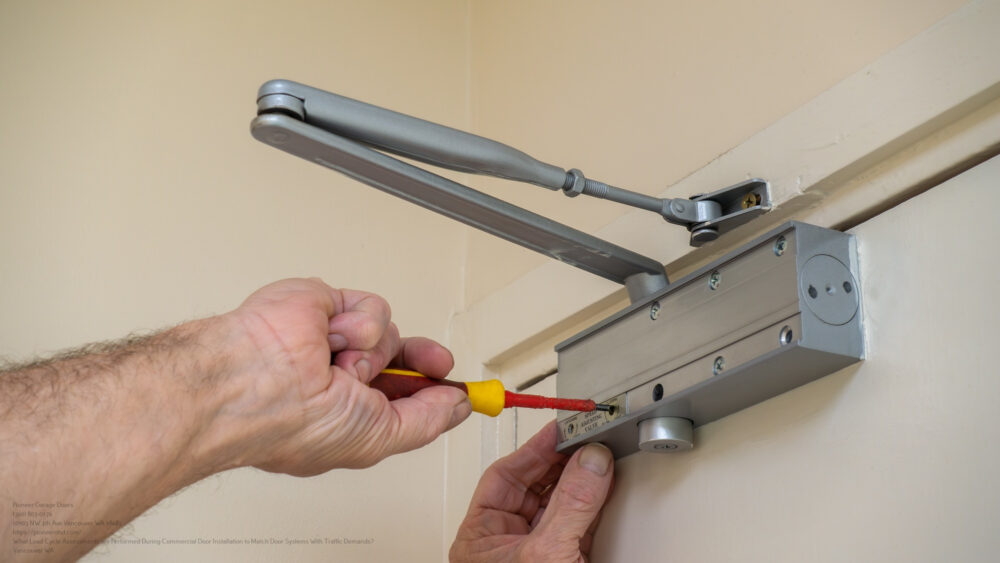
Facilities experiencing frequent activity place significant demands on components, including:
- Electronic locks,
- Alarm system integrations,
- Automatic opener setup configurations,
- Locking systems,
- Emergency release mechanisms.
Doors supporting emergency exit pathways must function reliably during critical moments. Facilities incorporating fire-rated assemblies must maintain compliance with standards that often include fire door drop-testing requirements.
According to the Door and Hardware Institute (DHI), proper installation practices contribute significantly to the long-term performance of commercial openings and associated hardware systems. Their educational resources emphasize the value of aligning door specifications with operational realities.
Safety isn’t achieved solely through product selection.
It results from understanding how systems behave under the demands placed upon them every single day.
Need Commercial Door Installation Solutions Tailored to Your Business Operations?
Contact Pioneer Garage Doors today and discover how precision planning improves long-term performance.
What 5 Operational Factors Influence Load Cycle Assessments Most?
Cycle analysis extends beyond counting openings. Pioneer Garage Doors evaluates multiple variables to understand how facilities truly function.
1. Daily Traffic Frequency
Businesses operating within Vancouver WA, Battle Ground, and the broader Portland Metro area experience vastly different traffic patterns. Retail environments differ considerably from industrial settings, utilizing loading dock systems.
2. Peak Usage Periods
Some facilities encounter concentrated bursts of activity. Morning deliveries, shift changes, and seasonal demand fluctuations can accelerate wear significantly.
3. Environmental Conditions
Moisture, temperature changes, and airborne contaminants affect system performance. Facilities near shipping corridors often require enhanced durability.
4. Security Expectations
Doors supporting advanced security solutions, electronic locks, and multi-point locking systems demand careful integration during planning.
5. Future Growth Projections
Businesses anticipating expansion benefit from proactive system upgrades that accommodate evolving operational demands.
Evaluating these considerations early enables technicians to recommend products that meet real-world performance expectations.
Could the Wrong Door System Create Hidden Costs Over Time?
Choosing the wrong commercial door doesn’t always produce immediate problems. Often, operational inefficiencies emerge gradually.
Imagine a busy warehouse selecting equipment intended for moderate use. Initially, everything appears satisfactory. Months later, however, repeated strain begins affecting tracks, operators, and spring assemblies. Maintenance requirements increase. Downtime disrupts productivity. Replacement timelines accelerate unexpectedly.
Facilities that rely heavily on commercial door services often find that initial savings disappear when systems fail to match traffic realities.
Businesses may encounter:
- Increased frequency of repair services,
- Premature spring fatigue,
- Accelerated operator wear,
- Declining energy efficiency,
- Reduced employee productivity.
Professional installation teams recognize these risks before equipment selection occurs.
A commercial door system should support operations rather than restrict them.
How Commercial Door Installation Projects Align Hardware With Demand
The strongest commercial installations don’t happen by accident. They emerge through deliberate planning informed by technical expertise.
During commercial door installation in Vancouver WA projects, technicians evaluate hardware compatibility alongside projected cycle demands. Different environments require different solutions.
For example:
High-speed sectional doors may support facilities prioritizing operational efficiency and climate control.
rolling steel options often suit environments demanding exceptional durability.
Facilities requiring enhanced security may benefit from integrated electronic locking mechanisms, security access hardware, and keypad system functionality.
Properties emphasizing life-safety considerations may require panic bar installations alongside fire code-compliant assemblies.
Meanwhile, loading facilities often prioritize compatibility between overhead door and loading dock equipment, vehicle restraint systems, and associated dock infrastructure.
Are Specialty Commercial Systems Evaluated Differently?
Not every commercial application follows identical assessment protocols.
A retail establishment emphasizing customer experience may prioritize aesthetics alongside functionality. Security grilles, gates, and shutters are frequently used by businesses requiring after-hours protection without sacrificing visual appeal.
Industrial environments that rely on overhead coiling doors demand rugged construction capable of withstanding intensive use.
Facilities incorporating loading dock seals and shelters require coordination between dock equipment and door operation to maintain environmental separation.
Buildings featuring unusually sized door systems introduce additional engineering considerations influencing component selection.
Healthcare facilities frequently integrate automatic pedestrian door technology designed to enhance accessibility and operational flow.
These differences reinforce an important reality: traffic analysis should always align with application-specific requirements rather than generic assumptions.
How Do Property Managers Build a Smarter Decision Framework for Door Investments?
Property managers often balance competing priorities. They want dependable operation, cost-effective solutions, attractive aesthetics, and systems that can support future growth. That’s where load cycle assessments become particularly valuable.
A facility operating in Vancouver, WA may initially require only moderate traffic capacity. However, tenant turnover, business expansion, or changing operational demands can quickly alter usage patterns. Selecting equipment designed only for current requirements can lead to avoidable replacement costs later.
Pioneer Garage Doors encourages businesses to evaluate commercial door investments using a broader decision framework:
- What are current daily cycle expectations?
- Will future growth increase traffic volume?
- Are there planned system upgrades?
- Do safety requirements involve advanced access control?
- Will the facility benefit from enhanced energy efficiency?
This planning approach supports stronger long-term outcomes while minimizing unnecessary disruptions.
What Makes Pioneer Garage Doors the Trusted Choice for Commercial Installations?
Commercial installations require more than technical knowledge. They demand responsiveness, communication, and an understanding of how businesses operate.
Pioneer Garage Doors approaches each project with a commitment to customer service, practical problem-solving, and long-term reliability. Whether supporting property managers overseeing mixed-use developments or industrial facilities managing extensive logistics operations, the goal remains consistent: deliver solutions aligned with operational realities.
Businesses throughout Vancouver WA, the surrounding Portland Metro, and nearby communities benefit from installation teams that prioritize precision during every phase of the project.
The company’s approach emphasizes:
- Comprehensive site evaluations,
- Transparent recommendations,
- Dependable installation practices,
- Continued support opportunities,
- Strong customer satisfaction outcomes.
Commercial properties depend upon doors functioning reliably day after day. Pioneer Garage Doors understands what’s at stake when those expectations aren’t met.
Choosing Pioneer Garage Doors is Choosing Performance Built Around Real World Demands
We at Pioneer Garage Doors provide the best solutions to our customers because we recognize that every commercial facility operates differently. Understanding load cycles enables us to recommend systems that support both current demands and future growth opportunities.
Our team delivers dependable installation services supported by technical expertise, responsive customer care, and a commitment to lasting value. From evaluating traffic expectations to recommending compatible hardware configurations, we help businesses make informed decisions.
We proudly provide exceptional commercial door solutions that prioritize durability, efficiency, and operational precision. Our dedication to quality workmanship ensures businesses receive installations designed for long-term success.
Contact Pioneer Garage Doors today for expert commercial door services tailored to your facility’s needs. Businesses seeking dependable solutions continue relying on Pioneer Garage Doors for trusted commercial door installation in Vancouver WA.
Need Commercial Door Installation Solutions Tailored to Your Business Operations?
Contact Pioneer Garage Doors today and discover how precision planning improves long-term performance.